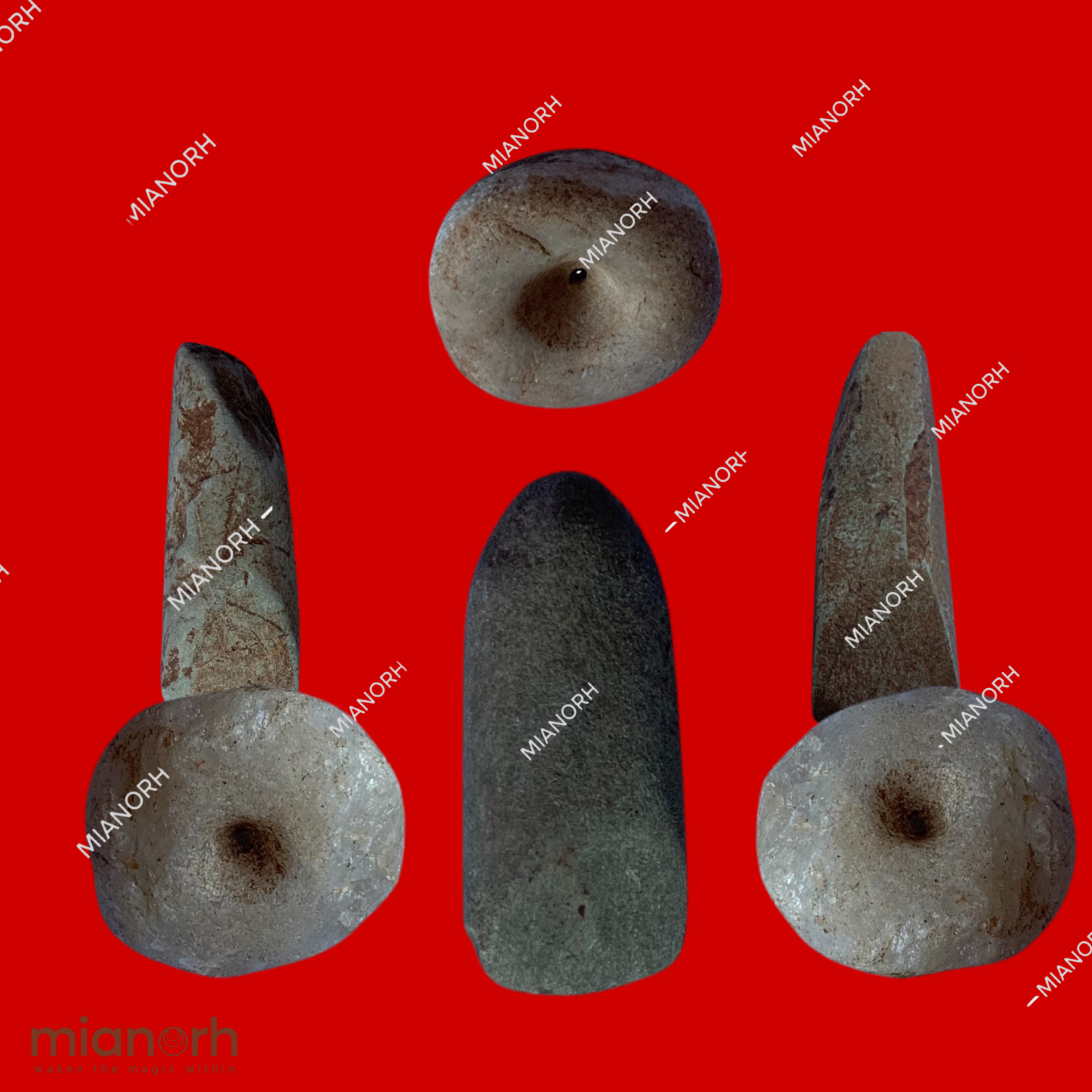

Thunderstones are often misunderstood.
At a glance, they appear simple—small, grounded, unassuming stones. But within ritual practice, thunderstones are regarded as objects of force, boundary, and response.
They are not decorative.
They are not passive.
And they are not used casually.
What Are Thunderstones?
Thunderstones are natural or found stone forms associated with energetic force, protection, boundary-setting, and presence.
In some traditions, they are also linked to deities of thunder and lightning, such as Shango (Ṣàngó) in the Yoruba tradition, where they are understood as objects carrying force, authority, and response.
They are often worked with in ritual systems involving:
- protection and energetic defense
- cleansing and clearing
- strengthening personal and spatial boundaries
- stabilizing environments
Their significance is not only in what they represent, but in how they are engaged.
Without intention, they remain dormant.
With clarity, they become precise.
Why Thunderstones Are Often Misunderstood
The most common misunderstanding is treating thunderstones as symbolic or decorative objects rather than functional ritual tools.
They are often:
- placed without intention
- moved frequently without purpose
- used across multiple intentions at once
In this state, their function becomes diffuse.
Nothing appears to shift.
The Role of Intention and Structure
Working with thunderstones is not about complexity.
It is about:
- timing
- placement
- clarity
- restraint
Small shifts in approach can completely alter the experience of working with them.
The Ways Thunderstones Are Commonly Worked With
Thunderstones may be engaged in relation to:
- water
- thresholds
- personal carrying
- space stabilization
Each method carries its own structure, timing, and handling principles.
Without this structure, the work becomes unfocused and less effective.
Before You Work With Them
There are a few foundational principles:
- not every moment is suitable for engagement
- emotional state influences clarity of use
- overuse reduces coherence
- placement is more important than quantity
These principles are often overlooked, yet central to the practice.
Final Thought
Thunderstones are not complicated.
But they are not casual.
They respond directly to how they are approached.
The Full Guide
For those who want to work with them properly, the Thunderstone Ritual Guide: Uses & Sacred Handling offers a complete framework, including:
- exact methods of use (water, thresholds, personal, space)
- handling and storage practices
- ritual cleanliness and preservation of function
- common mistakes and how to avoid them
This is a structured guide for intentional work with thunderstones.
Access the Full Ritual Guide
The Thunderstone Ritual Guide is available as a downloadable sacred reference text within the Mianorh collection.
It is intended for those working intentionally with ritual objects and seeking deeper structure in their practice.
You may access it through the Mianorh store, within the Ritual Guides collection.
This is not a casual guide.
It is a reference for structured engagement.
Offered within Mianorh as part of the sacred living system of ritual objects, practices, and energetic work.
Add comment
Comments